


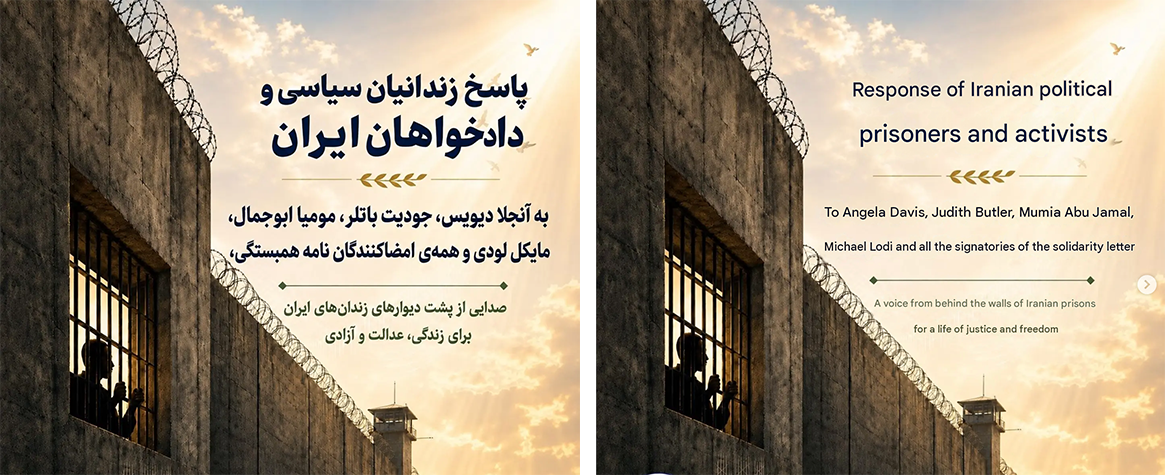
Introduction: Many prominent Iranian activists both inside Iran and in the Iranian diaspora have defended and explained their support for the Open Letter to Political Prisoners in Iran posted in The Guardian Opinion section August 20, 2026, including Solidarity Beyond Ideological Camps. The following text is particularly poignant because it is said to originate from political prisoners and justice seekers inside Iran. It was posted by @iranglobalnetworkfpp in Farsi on September 2 and as a video in English on September 20.
The response of Iran's Political Prisoners and Justice Seekers to Angela Davis, Judith Butler, Mumia Abu-Jamal, Michael Löwy, and All Signatories to the Letter of Solidarity:
From behind the tall walls and locked cells of Iran's prisons, we heard your voice. Your letter reached us at a time when the internet in Iran and been shut down and the authorities were making justice-seekers pay for the war. We had hoped that the cries of imprisoned justice seekers, subjected to such injustice, would reach you, even though telephone and family visits remain restricted, the sound of the prison guard's key robs us of sleep every night, and some of our fellow prisoners are being taken to the gallows.
Through torture and execution, they authorities are eliminating those who demanded life in order to preserve the power and wealth they have plundered.
Under the most brutal torture and during the darkest period of our lives, we sincerely thank you for your solidarity. That you have seen us and spoken our names amid all the clamor of war and censorship is a small light for us, as we breathe in the darkness of the cells.
As you rightly wrote, we are trapped between the two blades of a pair of scissors. On one side stands an apparatus that sends us, for the crime of protesting, writing, or even contacting the media, to cells where death is ever-present; and on the other are the bombs and sanctions that come crashing down upon ordinary people. We feel this reality in our flesh and bones every day.
Let us tell you about a place that is rarely seen.
In the so-called suites of Qezel Hesar Prison, the cell doors remain locked at all times. The toilet is inside the same four walls. A prisoner leaves the cell only for interrogation, trial, or execution. Prisoners are stripped of their own clothes and forced to wear Dalton-style striped uniforms. Their hair and beards are shaved so that everyone is made to look the same.
In this space, death is no longer an exception; it has become routine.
In the middle of the night, the door opens and a voice says: "Come out. The officer in charges wants you." Sometimes they ask: "Have you written your will?"
Young men who have not yet turned twenty move their necks from side to side so their muscles will be ready for the noose.
When they take one of them and he does not return, a guard says: "He no longer needs a blanket."
He has been taken to the rear courtyard, to the gallows. These are not imaginary scenes. We have witnessed them.
Although this prison is located near the capital and is subject to at least some monitoring, prisoners in smaller and more remote cities are clearly under even greater pressure.
And now, with the escalation of the war, the pressure had mounted even further. Executions have accelerated, psychological torture has intensified, and justice seekers—mothers, fathers, spouses, and those whose only demand is justice for their loved ones— are being increasingly hemmed in.
Many of us are facing new cases. Some are still awaiting sentencing, and every night they fall asleep with the same question: Whose turn is next?
Under these circumstances, your support is vital to us.
But we need broader support: the support of every awakened conscience, everywhere in this world. Support must not remain confined to letters. We need sustained pressure for an immediate halt to executions, access to prisons for independent inspectors, the release of political prisoners and prisoners of conscience, and an end to the inhuman conditions of solitary confinement cells and prison suites where death is ever-present.
We need narratives that do not allow death and torture to become normalized.
We need a form of solidarity that carries our voices beyond these walls and raises the cost of repression for any power that instrumentalizes human life.
We ask you, and everyone who reads this letter: Keep the names of prisoners at risk alive. Monitor their medical conditions and legal cases. Do not let us be forgotten in the shadow of war and crisis.
True solidarity means that we neither surrender to one blade of the scissors nor ignore the other.
We are still here. We are still breathing. We still stand by the promise we made to one another: we will not surrender.
And your voice, if it continues and spreads, can become part of a rope that pulls us out of this darkness.
With respect and in the hope of broader solidarity, A Group of Political Prisoners and Justice Seekers in Iran
From behind the tall walls and locked cells of Iran's prisons, we heard your voice. Your letter reached us at a time when the internet in Iran and been shut down and the authorities were making justice-seekers pay for the war. We had hoped that the cries of imprisoned justice seekers, subjected to such injustice, would reach you, even though telephone and family visits remain restricted, the sound of the prison guard's key robs us of sleep every night, and some of our fellow prisoners are being taken to the gallows.
Through torture and execution, they authorities are eliminating those who demanded life in order to preserve the power and wealth they have plundered.
Under the most brutal torture and during the darkest period of our lives, we sincerely thank you for your solidarity. That you have seen us and spoken our names amid all the clamor of war and censorship is a small light for us, as we breathe in the darkness of the cells.
As you rightly wrote, we are trapped between the two blades of a pair of scissors. On one side stands an apparatus that sends us, for the crime of protesting, writing, or even contacting the media, to cells where death is ever-present; and on the other are the bombs and sanctions that come crashing down upon ordinary people. We feel this reality in our flesh and bones every day.
Let us tell you about a place that is rarely seen.
In the so-called suites of Qezel Hesar Prison, the cell doors remain locked at all times. The toilet is inside the same four walls. A prisoner leaves the cell only for interrogation, trial, or execution. Prisoners are stripped of their own clothes and forced to wear Dalton-style striped uniforms. Their hair and beards are shaved so that everyone is made to look the same.
In this space, death is no longer an exception; it has become routine.
In the middle of the night, the door opens and a voice says: "Come out. The officer in charges wants you." Sometimes they ask: "Have you written your will?"
Young men who have not yet turned twenty move their necks from side to side so their muscles will be ready for the noose.
When they take one of them and he does not return, a guard says: "He no longer needs a blanket."
He has been taken to the rear courtyard, to the gallows. These are not imaginary scenes. We have witnessed them.
Although this prison is located near the capital and is subject to at least some monitoring, prisoners in smaller and more remote cities are clearly under even greater pressure.
And now, with the escalation of the war, the pressure had mounted even further. Executions have accelerated, psychological torture has intensified, and justice seekers—mothers, fathers, spouses, and those whose only demand is justice for their loved ones— are being increasingly hemmed in.
Many of us are facing new cases. Some are still awaiting sentencing, and every night they fall asleep with the same question: Whose turn is next?
Under these circumstances, your support is vital to us.
But we need broader support: the support of every awakened conscience, everywhere in this world. Support must not remain confined to letters. We need sustained pressure for an immediate halt to executions, access to prisons for independent inspectors, the release of political prisoners and prisoners of conscience, and an end to the inhuman conditions of solitary confinement cells and prison suites where death is ever-present.
We need narratives that do not allow death and torture to become normalized.
We need a form of solidarity that carries our voices beyond these walls and raises the cost of repression for any power that instrumentalizes human life.
We ask you, and everyone who reads this letter: Keep the names of prisoners at risk alive. Monitor their medical conditions and legal cases. Do not let us be forgotten in the shadow of war and crisis.
True solidarity means that we neither surrender to one blade of the scissors nor ignore the other.
We are still here. We are still breathing. We still stand by the promise we made to one another: we will not surrender.
And your voice, if it continues and spreads, can become part of a rope that pulls us out of this darkness.
With respect and in the hope of broader solidarity, A Group of Political Prisoners and Justice Seekers in Iran