


Update:
"This statement has been signed by over 100 Iranian former political prisoners, union activists, academics, members of the Writers' Association of Iran who currently live inside Iran, as well as those living in exile, in solidarity with Iranian prisoners and in condemnation of the ongoing war. The statement was released today in support of the letter signed by prominent world intellectuals, published on August 20 in the Guardian, and in response to the controversy surrounding it. The courage of the signatories from inside Iran who are facing the most brutal wave of state repression is deeply admirable and inspiring." -- Fatemeh Shams (aka Shahrzad),) @faatemehshams
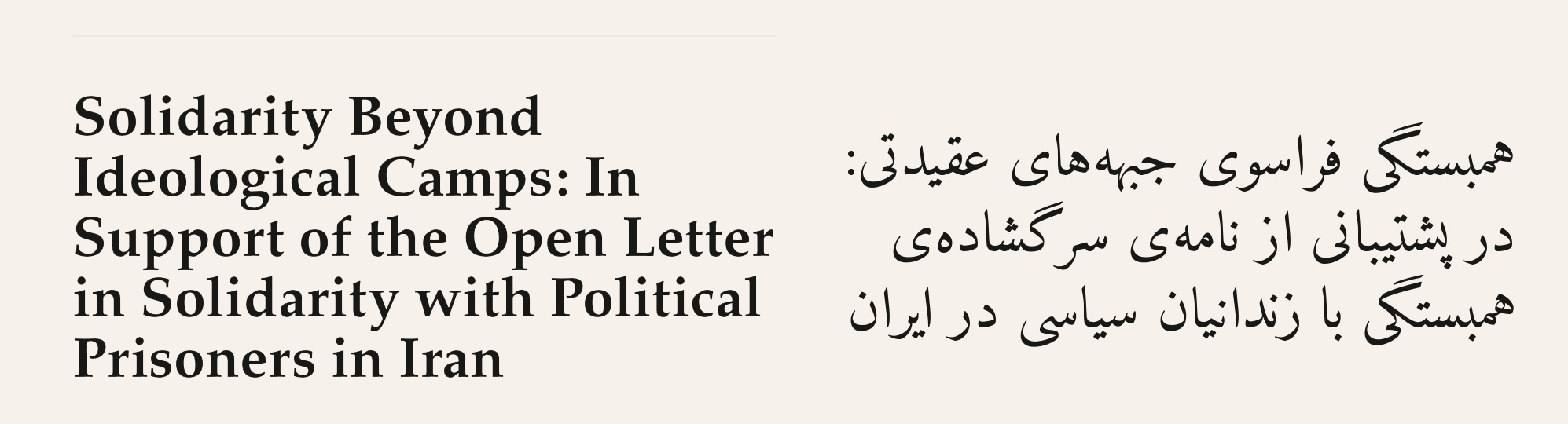
IEC is posting this statement in full in English to spread it as broadly as possible. It is available in both English and Farsi as a Google doc.
We, the undersigned former Iranian political prisoners, activists, writers, artists, intellectuals, academic scholars, researchers, and members of civil society within Iran and in exile, stand resolutely in support of the open letter published in The Guardian on 20 August 2026, "To Iran's Political Prisoners, Trapped 'Between Two Blades of A Scissors.'" Its core principle is clear: the Iranian people must not be forced to choose between external military and economic aggression and state repression.
We echo its call to immediately halt executions, release all political prisoners, end the war, and end the collective punishment of the Iranian people. We commend the signatories' historic act to build solidarity with the Iranian people by foregrounding the struggle of political prisoners directly subjected to state repression.
Employing the metaphor of "two blades of a scissors" to describe the predicament of Iranians facing both war and state repression does not suggest moral or political equivalence. To acknowledge and condemn multiple forms and sources of violence is not to erase their origins or conflate their intentions. Rather, this metaphor centers the lived reality of those trapped between irreconcilable pressures.
The binary logic that demands exclusive allegiance to either the Islamic Republic or imperialist powers is both philosophically unsound and ethically impoverished. Moral clarity lies not in collapsing distinctions, but in refusing to let one form of domination justify another. True solidarity rejects the false dilemma of choosing between injustices; it demands opposition to all systems of repression and oppression that ensnare the vulnerable.
The signatories of the letter have compellingly argued that a state may be both the object of external aggression and the agent of internal repression; these truths must be held together. Iran's history is marked by foreign intervention-including the Russian-backed bombardment of the Iranian parliament after the 1908 Constitutional Revolution, the CIA-MI6-orchestrated 1953 coup, and more recent sanctions and the current US-Israeli war against Iran.
It is also marked by state repression before and after the 1979 Revolution - including political
imprisonment, executions, forced veiling as a form of gender apartheid, censorship, suppression of civil society and religious minorities, and the systemic oppression of Kurds, Baluchis, Arabs, and Turks of Iran.
Years of systemic repression and the persecution of civil movements, unions, and activists inside Iran have effectively made the possibility of any structural and transformative political change from within the country exceedingly difficult.
Recognizing and condemning this dual reality is crucial: the suffering of the prisoners is not diminished by the predicament of their jailer, nor can their rights be rendered contingent on geopolitics. Justice, freedom, and democracy, therefore, cannot be postponed or sacrificed in the name of the regime's so-called "anti-imperialist resistance" against external forces.
To those who consider the Islamic Republic the only force to support the Palestinian cause in the region, we must clarify: long before the Islamic Republic, the Iranian left played a central role in building networks of solidarity with progressive Palestinians, a legacy rooted in anti-colonial struggle and internationalism that did not start with the establishment of the Islamic Republic. This same leftist movement was the first victim of severe repression after the 1979 Revolution.
The mass execution of political prisoners in the summer of 1988 has been documented by numerous former Iranian political prisoners, scholars, and human rights organizations and amounts to a crime against humanity.
We reject the instrumentalization of Iranian suffering, whether as justification for foreign military intervention or as an excuse for domestic repression.
Iranian lives must not be manipulated for propaganda by any ideological camp.
The domestic laws of a sovereign state that result in the criminalization of protest and dissent, coerced confessions, sham trials, and the summary execution of prisoners without evidence are not a sign of the legitimacy of those laws, but rather a testament to their injustice, and must be opposed.
"Resistance" that turns a blind eye to the struggle of political prisoners is not worthy of that name. We stand in solidarity with all who resist domination, oppression, and imperialist wars.
1. Frieda Afary, writer, translator, librarian, Los Angeles, California, USA
2. Janet Afary, Professor of History, University of California, Santa Barbara, USA
3. Amir Ahmadi Arian, writer, Professor of Creative Writing, Binghamton University, USA, Iran
4. Hamid Akbari, Audrey Reynolds Professor Emeritus of Management, University of Chicago, Illinois, USA
5. Hossein Akbari, former political prisoner, writer, labor-union researcher, Iran
6. Reza Akrami, former political prisoner, political activist, France
7. Kazem Alamdari, Professor Emeritus of Sociology, California State University, USA
8. Aida Amidi, former political prisoner, poet, Iran
9. Batoul Arasteh, human rights activist, France
10. Shahrzad Arshadi, filmmaker, playwright, Canada
11. Maryam Ashrafi, photographer, social activist, France
12. Touraj Atabaki, Professor Emeritus of the Social History of the Middle East and Central Asia, Leiden University, Netherlands
13. Pouyesh Azizeddin, researcher in technology and human rights, Slovenia
14. Ali Banuazizi, Professor of Political Science, Boston College, USA
15. Monireh Baradaran, former political prisoner, human rights activist, writer, Germany
16. Nora Bayani, women's rights activist, USA
17. Mansoureh Behkish, leftist feminist activist, former political prisoner, member of the Mothers and Families of Khavaran, Ireland
18. Alireza Behnam, poet, translator, journalist, Iran
19. Alireza Behtoui, Professor of Sociology, Södertörn University, Sweden
20. Atena Daemi, former political prisoner, human rights activist, Canada
21. Mehrdad Darvishpour, sociologist, Associate Professor, senior lecturer in Social Work at Mälardalen University, Sweden
22. Armen Davoudian, poet, translator, Stanford University, USA
23. Amin Feizpour, Founder and Director of "Iran Circle", USA
24. Parastou Forouhar, artist, social activist, Germany
25. Halleh Ghorashi, professor of social sciences, Vrije University, Netherlands
26. Barbad Golshiri, artist, social activist, France
27. Mohammad Habibi, spokesperson for Iran's Teachers' Trade Association Council, Iran
28. Hadi Hiyali, former political prisoner, writer, Iran
29. Ali Hojat, former political prisoner, retired graphic designer, USA
30. Homa Hoodfar, women's rights activist, Professor Emeritus of Women's Studies, Concordia University, Canada
31. Guissou Jahangiri, former Secretary-General of the International Federation for Human Rights, women's rights defender, human rights activist, France
32. Pouria Jahanshad, researcher in social sciences, Iran
33. Milad Jannat, former political prisoner, poet, translator, Iran
34. Aso Javaheri, feminist activist, PhD student, Simon Fraser University, Canada
35. Mihan Jazani, political activist, France
36. Fatan Jokar, former political prisoner, human rights activist, Finland
37. Mehrangiz Kar, lawyer, women's rights activist, USA
38. Kazem Kardavani, social activist, researcher of social sciences, Germany
39. Golshid Karimian, former political prisoner, writer, researcher, Iran
40. Sara Karimian, Research Associate in Political Science, University of Sussex, England
41. Nasser Khandabi, former political prisoner, Canada
42. Reza Khandan, writer, Iran
43. Mina Khanlarzadeh, Professor of History, Deep Springs College, USA
44. Nasim Khaksar, novelist and writer, Netherlands
45. Azam Khatam, women and environmental rights activist, researcher, York University, Canada
46. Azar Khounani, Early Childhood Education Specialist, USA
47. Amir Kianpour, writer and researcher, Paris, France
48. Saeed Madani, former political prisoner, sociologist, Iran
49. Chowra Makaremi, researcher in anthropology, CNRS, France
50. Zaman Massoudi, political activist, Germany
51. Mahnaz Matin, doctor, researcher and women's rights activist, France
52. Farzaneh Milani, Professor Emerita of Gender Studies, University of Virginia, USA
53. Haideh Moghissi, Professor Emerita of Women's Studies, York University, Canada
54. Nasser Mohajer, advocate for the rights of political prisoners, researcher in Modern Iranian History, France
55. Shahrzad Mojab, feminist activist, Professor Emeritus of Women's Studies, University of Toronto, Canada
56. Saeed Molaei, former political prisoner, social activist, Iran
57. Esha Momeni, former political prisoner, lecturer of gender studies, University of California, Los Angeles, USA
58. Shaghayegh Moradi, former political prisoner, human rights activist, Iran
59. Manijeh Moradian, feminist activist, Professor of Women's Studies, Barnard College, New York, USA
60. Ghazaleh Motamed, set costume designer, feminist activist in the "Me Too" movement, France
61. Negar Mottahedeh, Professor of Comparative Literature, Duke University, USA
62. Hafez Mousavi, poet, writer, Iran
63. Shiva Nazar Ahari, former political prisoner, founding board member and spokesperson of the Committee of Human Rights Reporters, Slovenia
64. Mohammad Reza Nikfar, philosopher, Germany
65. Farhad Nomani, Professor Emeritus of Economics, American University of Paris, France
66. Kambiz Norouzizadeh, former political prisoner, human rights activist, Iran
67. Nader Ossareh, former political prisoner, political essayist, France
68. Saeed Paivandi, sociologist, Director of the LISE Research Center, University of Lorraine, France
69. Pouya Pour-Amin, former political prisoner, composer, sound designer, Norway
70. Nazanin Pouyandeh, painter, France
71. Anahita Rahmani, former political prisoner, Canada
72. Saeed Rahnema, Professor Emeritus of Political Science, York University, Canada
73. Hossein Razzagh, former political prisoner, political activist, Germany
74. Abdollah Rezaei, former political prisoner, teachers' union activist, Iran
75. Mona Roshan, former political prisoner, Canada
76. Somayeh Rostampour, researcher of social sciences, Kurdish feminist activist, France
77. Mihan Rousta, advocate for the rights of political prisoners, member of a family of people executed in the 1980s, Germany
78. Ali Sabouri, former political prisoner, poet, Iran
79. Khosrow Sadeghi Boroujeni, writer, journalist, Iran
80. Shokoufeh Sakhi, former political prisoner, Lecturer in Gender Studies, University of Toronto, Canada
81. Hossein Sarbandi, former political prisoner, political activist, Iran
82. Parisa Sardashti, writer, feminist activist, France
83. Nastaran Saremy, feminist and environmental activist, PhD student, Simon Fraser University, Canada
84. Faraj Sarkohi, former political prisoner, journalist, Germany
85. Khashayar Sefidi, former political prisoner, student movement activist, Iran
86. Asad Seif, writer, researcher, Germany
87. Siyavash Shahabi, journalist, social activist, Greece
88. Fatemeh Shams, poet, feminist activist, Professor of Literature, University of Pennsylvania, USA
89. Mansoureh Shojaee, former political prisoner, writer, women's rights activist, Netherlands
90. Roozbeh Sohani, former political prisoner, poet, Iran
91. Nasim Soltanbeygi, journalist, Iran
92. Amir Soltani, writer, social activist, advocate for political prisoners, USA
93. Nahid Taghavi, former political prisoner, women's rights activist, Germany
94. Jinoos Taghizadeh, activist, visual artist, Canada
95. Mona Tajali, women's rights activist, researcher in Women's Studies, Stanford University, USA
96. Manijeh Tam, cultural activist, France
97. Taghi Tam, former political prisoner, retired, France
98. Nayereh Tohidi, women's rights activist, Professor Emeritus of Women's Studies, California State University, USA
99. Mehrdad Vahabi, Professor of Economics, Sorbonne Paris North University, researcher at Paris Dauphine University, France
100. Saeed Yousef, former political prisoner, poet, Germany
101. Shirin Zakeri, researcher, adjunct professor of Iranian Studies, Sapienza University, Italy
102. Sara Zarei, poet, critic, labor rights activist, Iran
Click on any photo to view full-sized lightbox.