


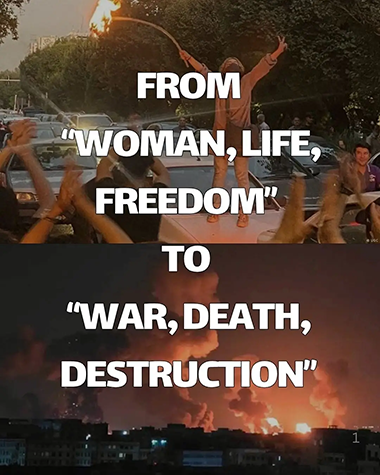
Four years have passed since the killing of Jina Mahsa Amini. Four years since the day her death shook Iran and opened to the world a wound that had existed for decades. Four years since the day women took to the streets, removed their headscarves, cut their hair, and pushed the Islamic Republic back on the ideological front, from one of its most important battlegrounds: compulsory hijab. They did so through an act that was simple, yet radical and continuous: We will no longer live the way you want us to.
The Jina uprising had both achievements and shortcomings; it was certainly full of contradictions and far from uniform. Contradictions that became more pronounced along the way. In 2023, part of it stood alongside Palestine and against the genocide, while in 2025-2026, another part welcomed American bombs falling on Iran. Our society became more polarized, and the “common enemy” was no longer only the Islamic Republic:
from the reactionary Pahlavi opposition, which in January called on people to go in front of the fire of the criminal rulers, to Israel and the United States, who, riding on the blood of our youth, legitimized their “war, death, and destruction.” We have gone from sixteen-year-old Nika Shakarami, killed by the Islamic Republic, to four-year-old Amirali, killed by an American bombing at a wedding celebration in Kuhestak: the graves are getting smaller and smaller…
We call on all people to stand against this organized assault on life and freedom, whether carried out through the bombs and sanctions of the world’s number-one criminal—USA—or through the executions and prisons of the anti-woman Islamic Republic. These are instruments of collective punishment that foreign powers and the domestic ruling clase—though on different scales—use against the people and in pursuit of their own interests. Any illusion that anything positive will emerge from U.S. plans or from the reactionary “resistance” of the Islamic Republic must be discarded. Today, building a movement of a deeply radical character in Iran depends upon such an understanding.
We remember the children of Minab, just as we remember Kian, Hadis, Sarina, and Jina. We remember the 3,500 people killed in the war, just as we remember the thousands killed in January. We remember the 3.2 million people displaced and the 2 million people who lost their jobs as a result of U.S. aggression in Iran, just as we remember the thousands imprisoned for raising their voices in protest;
every Baluch who has been shot, every queer person who has been tortured, every Kurd who has been executed, every Afghan who has been deported, every Bahá’í and nonbeliever who has been erased. We remember all of this not in order to equate the crimes of the United States and the Islamic Republic, but because we know that they are not opposed to one another and that all our suffering has its roots in a single system.
We remember the history of our struggles from the earliest days of the Islamic Republic against compulsory hijab and political repression. We are connected to the women who, on March 8, 1357 (1979), in the very first days after the Revolution, took to the streets and protested the imposition of compulsory hijab. The same women who had fought against the monarchy and against U.S. domination of Iran. That struggle has not ended. It has continued in homes, workplaces, universities, prisons, and streets. Every time a woman has refused to surrender her body to the state, that struggle has continued. Every time a human being has said “no” to domination, that struggle has continued.
And today it continues when we say “no” to aggression and bombing; when we say “no” to sanctions and economic pressure; when we say “no” to crushing the lives of ninety million people in Iran on the battlefield of competition between the United States and China; when we say “no” to the nuclear threats of fascist Trump; when we say “no” to becoming “collateral damage” in projects of regime change; when we say “no” to the imperialist capitalist system that has nothing for the majority of the world’s people except war, death, and destruction;
when we say “no” to executions and imprisonment; to patriarchy/male supremacy, national oppression, the suppression of thought and expression, and to the entirety of the Islamic Republic, including its reactionary resistance aimed at extracting concessions; when we say “no” to its “anti-imperialist” propaganda while it is itself part of this very system and has held our lives hostage to that system and its crises.
On the fourth anniversary of Jina, our only “yes” is to a struggle that can put an end to this madness, for a future determined by us ourselves—not by the interests of the imperialists, whether China and Russia or the United States, nor by their dependents, whether the Islamic Republic or Israel—for life, because life itself is worth living and fighting for.