


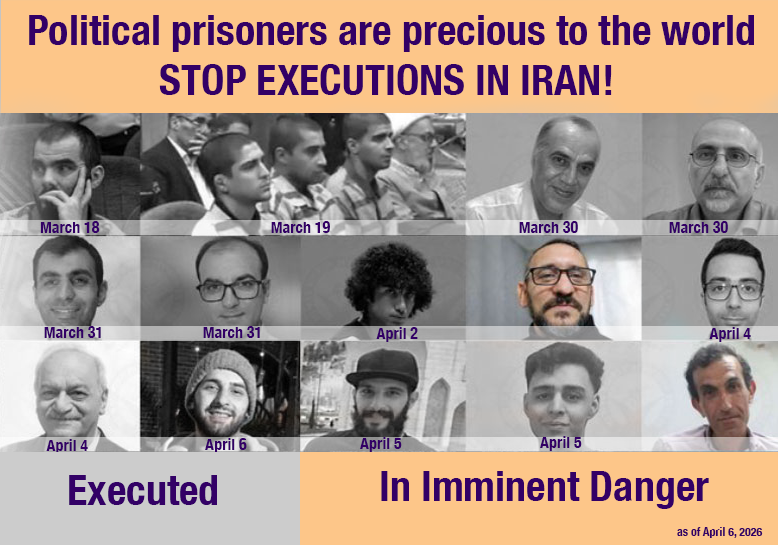

After 5+ weeks of war, Iran’s prisoners are caught between two blades of a scissors, as one ex-prisoner described it. The crimes committed by one “blade” are used as justification by the other: the U.S. and Israel commit massive war crimes, citing the IRI’s massacre of protesters, while the IRI labels people’s opposition with the catch-all charge of “sedition”. It’s the logic of one atrocity deserves another, a symbiotic macabre dance of death terrorizing Iran’s 93 million people.
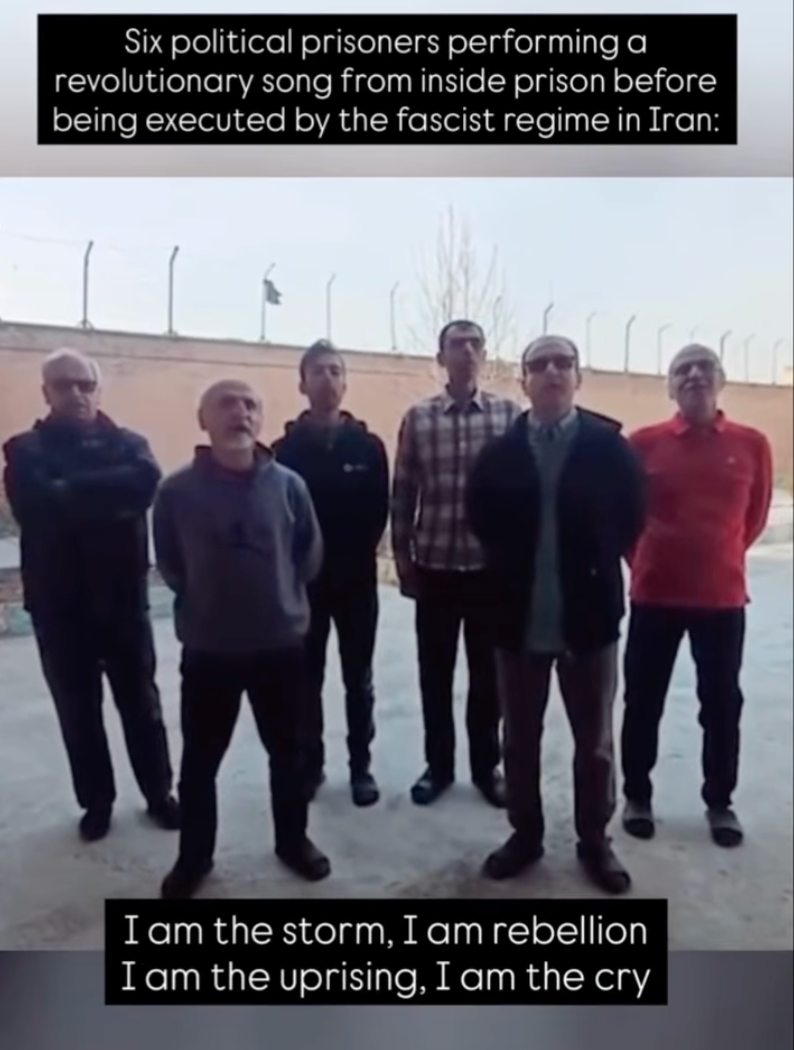
For those trapped inside Iran’s hellhole prisons, bombs explode nearby as fear grows of being the next casualties of the US/Israeli war. Windows and walls are damaged; food, medical care, family visits and phone calls are minimal or cut off as the prison staff has fled. Meanwhile, the IRI is accelerating executions and arrests of real and suspected political dissidents at a feverish pace.
There are daily reports of more activists being dragged from their homes by IRI police forces, such as the arrest of prominent defense lawyer Nasrin Sotoudeh on April 1. She has been on medical furlough but was previously sentenced to 38 years and 148 lashes (whipping) for her defense of women who rebelled against the forced hijab (head covering). Her activist husband, Reza Khandan, has been jailed in Evin prison since December 2024 for campaigning against Iran’s death penalty and the forced hijab.
On March 31, guards assaulted prisoners in Ghezel Hesar prison in Karaj (outside the capital of Tehran), the birthplace and political hub of the “No to Execution Tuesdays” prisoners’ hunger strike. They beat and violently removed at least 22 prisoners from the ward which housed political prisoners. Without warning, they executed two of the six prisoners convicted in the same court case. The remaining four were executed in the next few days. Their families have not been allowed to reclaim their bodies for burial. Yet even in the conditions of a near-total internet blackout, the courageous hunger strikers conveyed that they are continuing their protest strike, now in its 114th consecutive week in 56 prisons across Iran.
In the midst of war, executions are expected to rise dramatically. On March 4, days after the U.S.-Israeli bombings began, Iran’s top Judiciary chief declared that anyone who acts or speaks against the state “will be considered the enemy.” The regime’s intelligence agency warned that any citizens who protested would receive “a blow even stronger than that of January 8” (when many thousands were killed by the regime in just 48 hours, even by the IRI’s own conservative reports). Human Rights Activists New Agency (HRANA) noted that: “Based on the information collected, all executions carried out during this period have been tied to cases of a political nature, and no reports have been published of executions for non-political crimes during the same time frame. This points to a significant shift in the pattern of death penalty implementation in the country.”
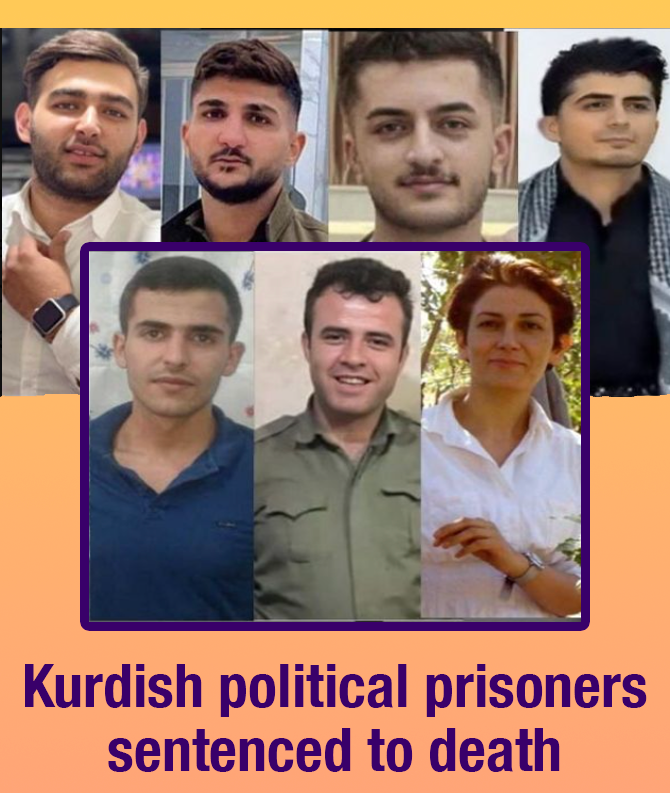
At the same time, the Kurdistan Human Rights Network reported that seven Kurdish political prisoners are currently sentenced to death on charges of “waging war against God”, including Pakhshan Azizi, condemned for her humanitarian work in Syria. Four have exhausted their appeals and so are in danger of being executed at any moment. Because the US has expressed hopes to make use of Kurdish forces (including via camps of armed Iranian Kurds in neighboring Iraq), the population of Iranian Kurdistan has suffered the largest number of US/Israeli bombardments on targets in the region, as well as heavy repression from the IRI.
Narges Mohammadi Must be Released after Untreated Heart Attack
On March 24 Nobel Peace Prize Laureate (2023) Narges Mohammadi suffered an untreated heart attack in Zanjan Prison [2]. She had been temporarily released from Evin Prison in November 2024 but in December 2025 the IRI violently rearrested her for speaking at a memorial of a civil rights lawyer, added 6 years to her sentence (now 18 years), and exiled her to the remote Zanjan Prison where she has had almost no contact with lawyers or family.
On March 31 the Free Narges Coalition Steering Committee said: “Narges Mohammadi’s life is in imminent danger, and we call on Iranian authorities to heed our warning and provide the medical care that she urgently needs, by granting her an immediate medical furlough.... Furthermore, we call for the immediate release on humanitarian grounds of all jailed human rights defenders, writers, and journalists; under these dangerous conditions, their safety can only be guaranteed by their removal from prisons and other detention zones, and Iranian law has provisions for their temporary release during wartime.”
Arrests and Executions More than Doubled during Previous Year
On March 24, Iran Human Rights NGO reported that: “Since the start of the war on 28 February, Islamic Republic authorities have announced the arrests of over 2,000 people... The charges against detainees include cooperation with and espionage for Israel and the United States, photographing sensitive sites and transmitting the images abroad, contact with diaspora Farsi-language media outlets, possession of satellite internet equipment including Starlink receivers, and in some cases attempts to organize anti-government gatherings or engage in armed confrontation with state forces, spreading public alarm, creating societal anxiety and insecurity and disrupting national security online.”
These accusations include activities which merely try to communicate what is happening in the war to others inside and outside Iran, including desperately worried friends and family. Among the arrested are dozens of political, union, and cultural activists, especially of members of the independent teachers’ union, university students and followers of the Baháʼí faith. These wartime arrests have come on top of huge numbers of arrests during the massive January 2026 protests. Since the Persian New Year based on the solar equinox in March, HRANA published its annual report of arrests, executions and other statistics. Of the almost 79,000 arrests in the previous Persian year, some 78,000 were for political and security charges. Between March 2025 – March 2026, the IRI executed at least 2,488 people, as individually verified by HRANA, which equates to one human being hanged every 3 ½ hours.
The horrific “two blades of the scissor” gripping people in Iran act as centrifugal forces that pressure people (both inside and outside Iran, including many non-Iranians) to “pick one side or the other” — either to side more virulently with the IRI against external attacks, or to double down on illusions that “regime change” ushered in with imperialist and Zionist bombs will end the IRI theocratic horror.
It is an outrage that the slander against all political dissent in Iran is repeated and justified by too many pro-regime apologists, even as the pro-U.S.-Israeli warmongering apologists have blood drenching their foul mouths. Both “choices” are against the interests of the masses of people in Iran. It is opposed to their ability to seek a way out of the madness for more than 70 years against oppression of all stripes. It throws Iran’s political prisoners under the bus, those who have so courageously struggled and risked all for a hope of a more just society.
It is significant that there ARE people inside and outside Iran, among political prisoners and their supporters in the diaspora, dissidents, various progressive rights forces, artists and cultural figures, as well as revolutionaries and communists, who are calling for another way forward in opposition to both the IRI and US/Israel, relying on the people themselves. It is the responsibility of all who crave justice and a better world to stand with Iran’s political prisoners at this very hour.
Here in the U.S., we have a special responsibility, living in the “belly of the beast”, to go all out to demand that US war stop the war crimes against Iran being waged in our name, to massively and firmly protest the U.S. empire’s threats to “Bring them back to the Stone Age” for what it is: genocidal fascism.

As part of this, we must bring home these points from the Emergency Appeal published by IEC in 2021: