


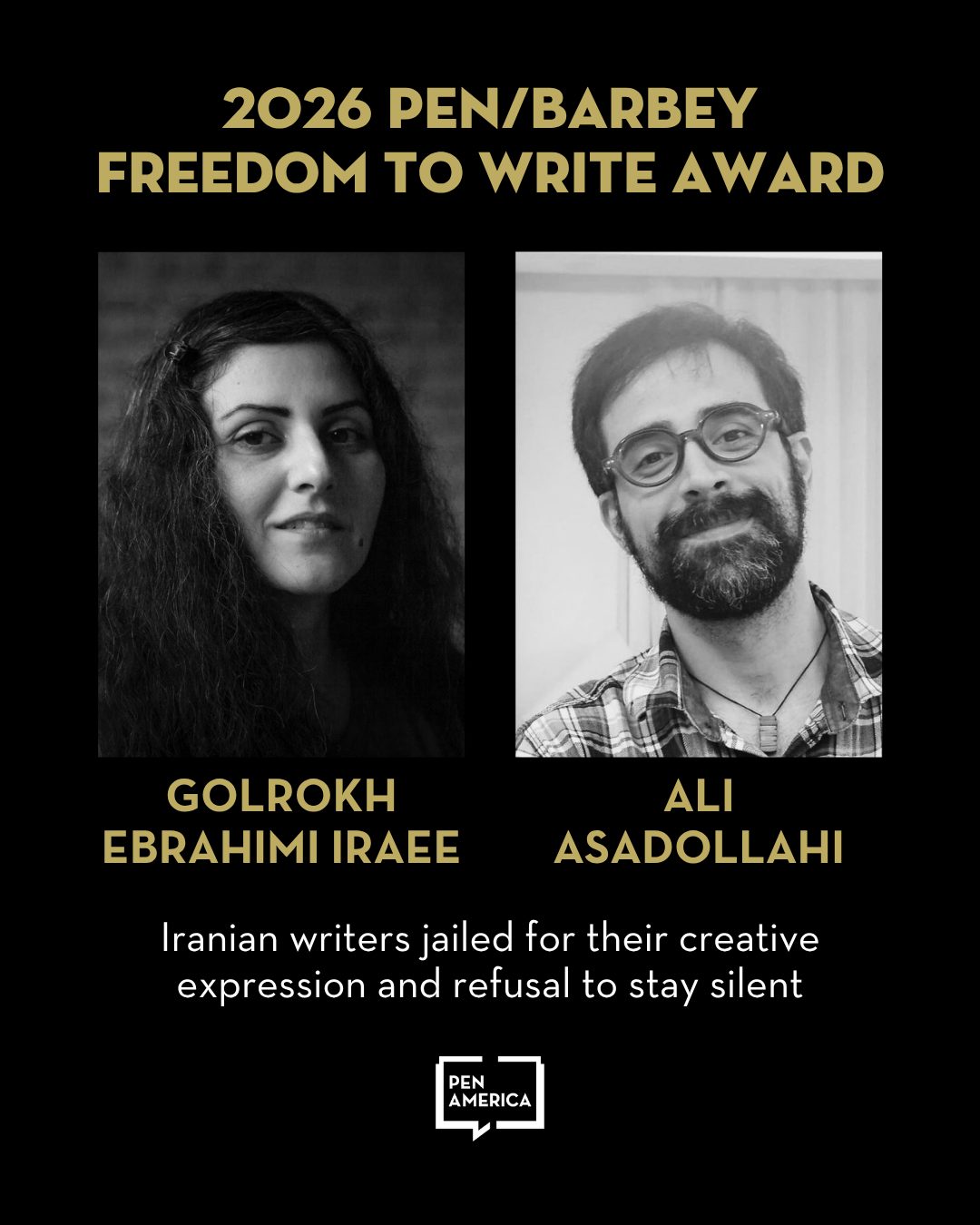
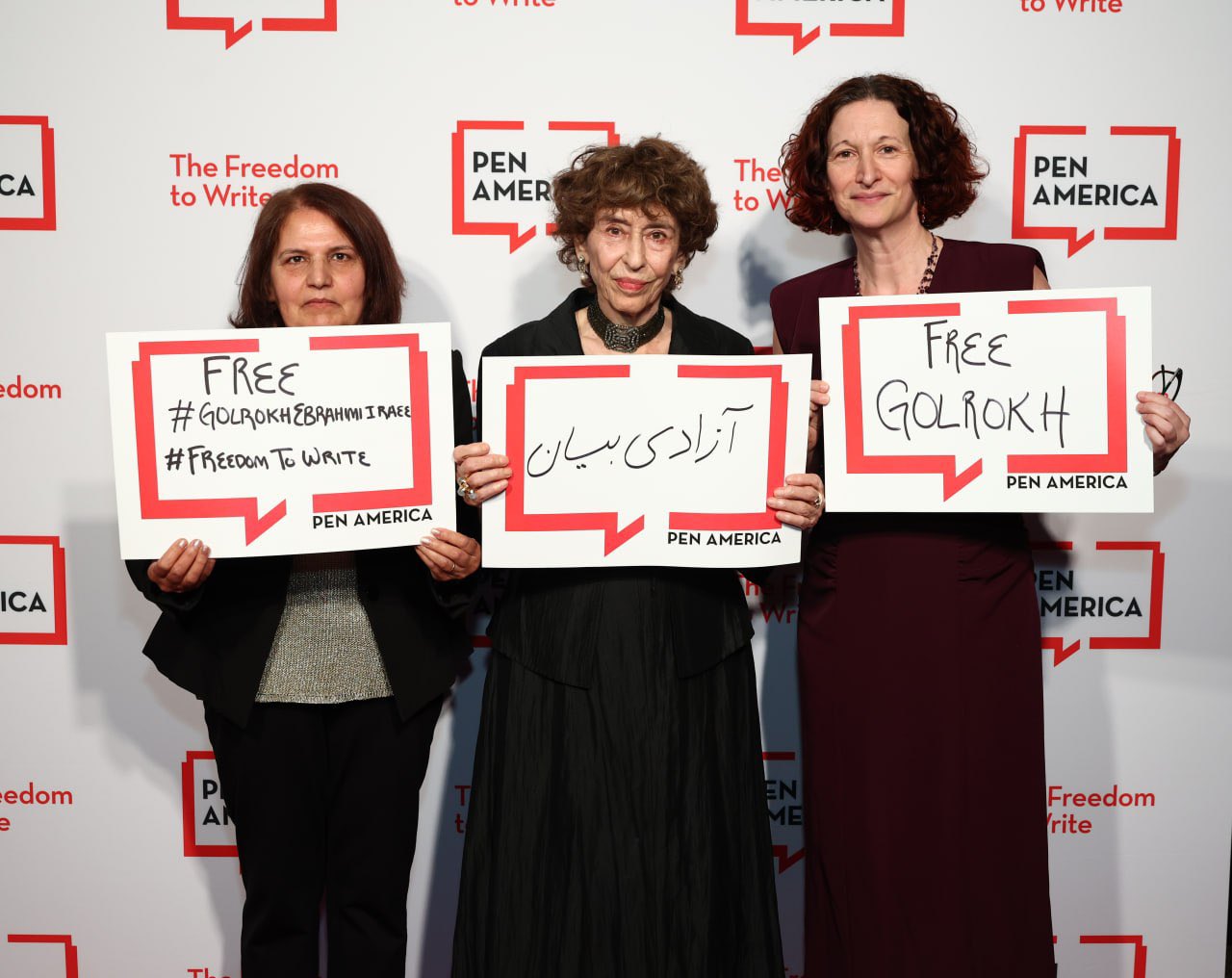
PEN America presented its 2026 "Freedom to Write" award in absentia to two Iranian writers: Golrokh Iraee, imprisoned in Evin, and Ali Asadollahi, recently released on bail. Golrokh, through supporters, was able to post on X this letter to PEN America's May 14 literary gala.
Read about Golrokh on PEN's website.
The following is a mechanical translation edited by IEC volunteers.
From a distant path, I send greetings to you who stand together in honor of “the freedom to write.” From a world where truths are denied the chance to emerge, and where breaking oppression and subjugation is not a simple right, but something only made possible through confrontation with rulers whose interests depend on the fear that shadows speech and action.
Here, to write fearlessly about the suffering of people who rise up against injustice is considered a crime. And “those who, with their pens, expose devastation and pain to the eyes of the world” are worn down in silence, branded criminals, and deemed worthy of being put on trial.
Writing about the suffering of oppressed people—about poverty, inequality, repression, and systematic killing— all of which have always been part of our lives, is not without consequences, but it is a window of hope, a motivation to struggle, and a spark to the erupting anger of people who live in suffocation. And, as history attests, the conscious and purposeful roar of their anger is the only way to dismantle oppression.
The ruling reactionaries in power cannot tolerate freedom of thought or the courage of expression when the “pen” attacks the erected gallows, narrates poverty and inequality, reflects empty dinner tables, and foretells the uprising of the hungry.
And so they stand against the pen, trying to break it. The “pen” that connects the bitter reality of today to the bright horizon of tomorrow, and shatters the silence imposed upon us through the relentless repression of more than a century of domination by “cleric and king,”(“sheikh and Shah”), with social awareness, political awareness, and class consciousness that can liberate the impoverished and the oppressed masses.
We write to resist the physical elimination of human beings, the erasure of thought, and the denial of political, ideological, and social beliefs and rights. We write to resist the destruction of values and convictions that have always been forced into exile and isolation.
We write even if our freedom is shackled. Even if we are threatened and restricted, forced into exile, or made to sacrifice our lives. Throughout the long years of ruthless dictatorship, from beneath the yoke of exploitation and reaction, we have sung and embodied this struggle in poems and slogans—from mountaintops, deep forests, and the streets of our cities, across a Middle East plundered by colonialism and assaulted by reactionary forces.
When the “pen” begins to write of the suffering of the people, it belongs neither to a set of borders, nor race or nationality, nor gender or color. The “pen” becomes a cry of shared pain against oppression—for us, who have entered into an unequal battle...
The “pen” becomes a cry over empty tables without bread.
It becomes the voice of grieving mothers, as they weep over the bodies of those valient martyrs carried on wagons of death toward unmarked graves.
It becomes a cry alongside the children of Palestine, as they carry the rage of occupation in the burden of displacement, while their dreams turn to smoke and drift away with the ashes of olive trees burned by the vengeance of executioners.
It becomes a cry in the final frightened gaze of the girls of Minab, amid dust and blood, their tangled hair clinging to their fragile necks.
It becomes a cry in the pursuit of justice by Mah-Monir Molayi-Rad, the mother of Kian Pirfalak—her son who was killed during the protests in Izeh—in her endless grief when she recalls the childlike games of Kian, and writes that injustice does not endure, and that the oppressor will face the consequences of his deeds.
The “pen” becomes a cry against every suffering and every injustice in every corner of the world. If it serves anything else, if it bends to expediency, then it has abandoned its mission.
And you, my dear friends, whose hearts beat to reveal the truth, whose concern is the unimpeded writing of reality—you who honor the “pen” and the struggle for equality and emancipation—your conscious and responsible efforts on behalf of oppressed people fighting for justice amplify the voices of the voiceless.
We will be freed from suffocation, and we know this will only be possible through a shared movement.
For the establishment of justice and equality—until humanity is emancipated from oppression and subjugation by rulers.
Golrokh Iraee
Ordibehesht 1405 (May 2026)
Women’s Ward, Evin Prison